


There’s a lot of silly advice out there about the ‘best way’ to market an education business. And there’s even more vague, surface-level content that claims to explain what that actually means… and fails to leave you feeling confident about which steps to take next.
It’s no wonder marketing feels so confusing for most educators I meet. But it doesn’t have to.
In this post, I breakdown the steps you need to successfully promote an education business, no matter what you teach.
Jump to…
- Education marketing essentials (don’t skip!)
- Getting clear on your core message
- Where should you market your school?
- How to know what works
Education marketing essentials
Marketing is essentially about connecting an audience with a product or service that will help them solve a problem. When done right, it gives them the information they need to make an informed purchasing decision. Not a guilt-complex for choosing not to move forward.
That starts, very simply, by doing something educators are great at…
Understanding who you’re speaking to
Most education business owners will loosely define their audience by age, sex, nationality and income level. This is useful background info, but it doesn’t tell you what you really need to know: why would they buy from you?
Instead of defining your ideal student as a young professional with brown hair and blue eyes named Susan, think about who they actually are.
What problems keep them up at night? What solutions have they tried before? What beliefs and values guide their purchasing decisions?
These details – otherwise known as psychographics – tell you so much more about what Susan responds to than whether or not she takes milk in her tea.
Okay, I’m exaggerating. But the point remains: how your ideal students think is more important than who they are.
📖 Not sure where to start with this? You might like this step-by-step guide to doing market research for your education business.
Defining the aim of your marketing
When you know who you’re speaking to, it’s time to think about what you want them to do.
For most education businesses, that’s purchasing a course, enrolling in lessons or subscribing to a membership. But what does that actually look like?
Does it start with an enquiry? A free trial class? Can students book directly? And what do they need to know before they even reach that point?
The answers to these questions are more important than you may think because they clarify the steps your students need to take between discovering you and learning with you.
This is known as your student journey, and defining it is key for mapping out your wider education marketing plan. That’s because it tells you what people need to know about your school or business at which point in time.
Describing your services in the right way
It’s easy to assume that saying, ‘We teach online English courses’ is enough to explain what you do.
But when Google displays 900,000 search results for one search term, how exactly are people supposed to know what makes you different?
Proving that you’re the school for your ideal students requires you to go much deeper than this.
You need to know:
- What problem your service solves
- Who exactly it’s made for (refer to your research from phase one)
- What alternatives these people are considering
- Why they should choose you over anyone else
The more detailed you can get, the easier it will be to move away from generic terms and catchphrases like this and catch attention through language that feels uniquely yours.
Identifying where you sit in the market
Why would your ideal student choose you over the school down the road? What is it specifically about your service that sets you apart?
You may already have an idea of what your unique selling point (USP) is. But a gut feeling isn’t enough.
You’ll need to conduct a full competitor analysis to understand what others are doing and how you fit into the wider landscape.
Sounds scary, I know. But you’d be surprised by how much this exercise can boost your confidence in what you do and how you do it.
Defining your core message
This is where your vision starts to come to life. Where you translate all the themes and ideas you’ve gathered into language that connects with the people you want to work with.
Look over your audience and competitor insights. What is that one thing you do that sits in the sweet spot between what your audience wants and what you do differently?
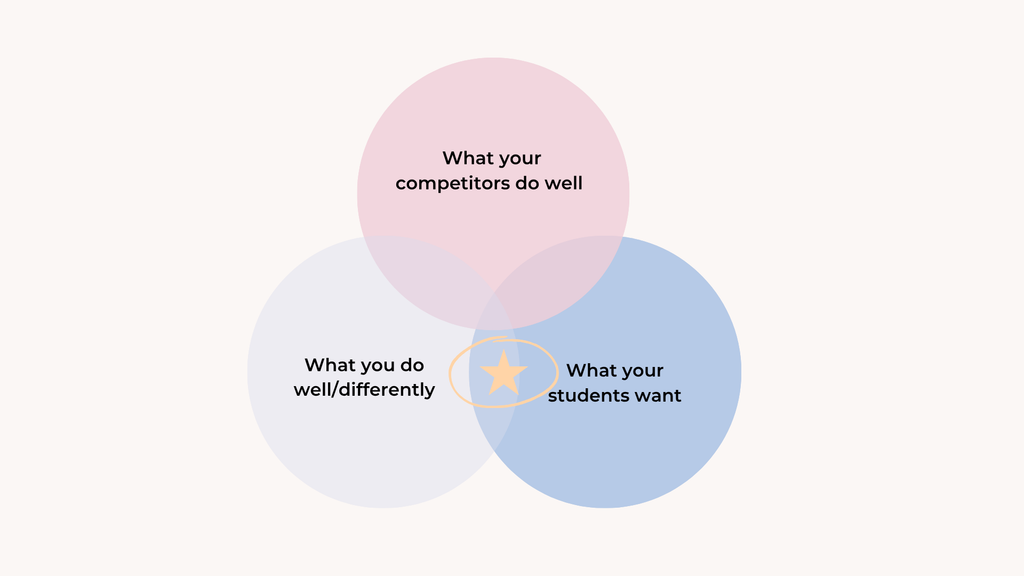
Take my client, Bruxelles, j’arrive!, for example.
Marie-Ange teaches Belgian French to expats in Belgium. She is far from the only teacher to offer this. But our research revealed that she is the only one who builds her lessons around the chaos and unpredictability of expat life.
This means her students don’t need to worry about wasting money on lessons they can’t always make, feeling guilty for falling behind or following a set syllabus that ignores what they’re really there to do: fit in and feel at home in Belgium.
That formed the foundation of everything I wrote for her website, making sure there’s no doubt in her ideal students’ minds that she’s the teacher they need.
The biggest messaging mistakes schools & educators make
Every sector has its vague marketing tropes. Tech bros ‘leverage’ everything. Wellness coaches are all about ‘high vibrations’ (whatever that means). And educators?
Well, you lovely people can’t seem to stop saying things like:
- Build confidence (what for?)
- Learn new skills (what kind?)
- Follow an innovative method (a what now?)
Take note: these phrases do not sell your services. They make your reader switch off because they’ve seen them a thousand times before.
If you want to stand out, you need to dig deeper into the specifics.
What does confidence look like for your students? What new skills will they learn specifically? And what on god’s green earth do you mean when you say your method is ‘innovative’?
Answer these questions, and marketing your education business will almost instantly feel easier.
📖 Read more about creating a messaging strategy that speaks to the right people.
Where should you market your education business?
You’ve got your key message. You’ve mapped out your student journey. Now it’s time to turn these insights into an actual plan.
I’m a big believer that less is more. Unless you’re a national school with multiple locations and a five-person marketing team, you do not need to be everywhere all the time.
Instead, think strategically about which channels you’re using and why.
Here’s a framework to put that into context:

I recommend focusing on one or two channels from each of the sections below. At least until you’ve found your flow, you’re seeing results and you’re ready to scale.
DISCOVER
These are ‘discovery’ channels – places where potential students may stumble upon your content and learn about your school without needing to commit to anything.
This includes:
Social media
Any public social media channel falls into this category.
While social media can of course be used to sell, it mainly sits at the top of the funnel, drawing new people into your world.
A good education content strategy recognises this and includes content that attracts new followers, connects with existing ones and promotes your services at regular intervals.
Blogging
There’s no doubt that AI has changed blogging and search engine optimisation (SEO) for good. But even in the age of AI overviews, blogs remain an unrivalled discovery tool.
That’s because they give you the ability to show up with helpful information right when your ideal students need it.
Well-written, informative posts won’t only show up on Google or in the AI overview. They’ll also inform AI algorithms, which means your advice may be recommended by the likes of Claude and ChatGPT.
As a writer, I am all too aware of the ethical issues surrounding this, particularly with regards to plagiarism and consent.
But as a marketer, I can’t not tell you to build AISEO into your education blogging strategy. Because as the tech bros repeatedly tell us: it’s here to stay.
Google, Meta or YouTube Ads
Do ads sound like a great way to grow your school quickly? Sure.
Should you run them to promote your services? Probably not.
Ads are great for amplifying what already works. Like getting more visitors to a sales page that’s converting or promoting a lead magnet that’s done well in the past.
But they won’t fill courses that no one’s booking through your existing marketing efforts. In this case, they’ll only highlight the cracks in your strategy and waste money in the process.
Long story short? There’s a time and a place for ads, but the fact you’re reading this post tells me that it’s probably not now.
📖 Is it worth running Facebook ads for your school? Read more here.
CONNECT
Once you’ve brought people into your world, it’s time to invite them to engage with you further. There are a handful of channels you can use to do this.
Email marketing
There’s a reason every marketer and their friend tells you to start an email list, and that’s because it has the highest return on investment of any marketing channel.
Unlike social media, your email subscribers need to actively opt-in to hear from you. By subscribing, they’re saying that they want to read more of your content, which suggests they’re that bit closer to wanting to learn with you.
Email allows you to deepen that relationship with your audience because it feels like you’re speaking directly to the reader. Not the 1000 other people who’ve commented below.
Lead Magnets
Once you’ve started an email list, you’ll need a way to promote it consistently. One effective way to do this is to launch a free resource that subscribers can access in exchange for sharing their email address.
I have to admit, this approach is starting to feel a bit dated. I don’t know anyone whose downloads file isn’t crammed with unopened PDFs they downloaded on a whim.
It still works, but you might need to get a little more creative now if you want your resources to stand out.
Trial lessons/webinars
At this stage of the student journey, potential students want to know more about what you do. They’re interested in getting a feel for your method and approach and seeing how the values that run through your content play out in a real lesson.
Now, the jury’s out over whether or not a free trial lesson is the right way to do this. It can be effective for some schools when set up in the right way.
But if your time is limited or your conversion rates are low, one alternative is to host a webinar or live event which multiple people can join at once.
By giving potential students a chance to engage with you, ask questions and learn more about your method, you deepen your relationship with them and strengthen the Know, Like, Trust factor.
Note: a blog can also play a key role in this stage of the journey by helping people better understand a problem and the right solution. But you can read more about that in this post.
CONVERT
Website
By the time you’ve developed a multi-channel marketing strategy, you have bookings and an established point of view, your website needs to pull its weight. Because it’s still one of the most important ways to market your education business.
All the people you’ve reached through your social media, blog and email content will visit your website. And they’ll make a snap decision as to whether or not to learn with you when they arrive.
Your website needs to:
- Tell your school or organisation’s story
- Show up for relevant search terms (on Google + AI)
- Answer your students’ biggest questions
- Spotlight your brand personality
- And sell your services
When it ticks all these boxes, your website can be your most powerful, long-lasting marketing tool, giving you the chance to take a break from posting without it impacting your sales.
Email marketing (yep, again)
Email isn’t just about building relationships with your audience. It’s also where a large percentage of sales come from.
Alongside your regular newsletter, try building out automated email sequences that send targeted messages to subscribers at pre-defined stages of the student journey.
This approach frees up a surprising amount of time, taking care of follow ups, booking reminders and course information without you needing to think about it all the time.
📖 Read more: 4 email sequences every education business should have
Measuring your results
Marketers have a dirty little secret.
None of us can say with certainty what will increase sales. Sure, we can take an educated guess at why one headline will outperform another or what message will land with a specific audience. But we won’t know for sure until we try.
That’s why it’s important to measure every single thing you do.
Data reveals both what you do and don’t want to see. It grounds you. It guides you. It gives you the confidence to continue down one path or pivot and try another.
I won’t go into the details of marketing tracking here because this post is long enough, and you have work to do. But when the time comes to assess your performance, you might find this post useful.
By now, you should have a better understanding of how to market your education business.
These steps apply whether you’re running an extra-curricular activity club, a traditional school or a service-based business serving the education community.
I would love to hear how you get on. Drop me a message on Instagram @simplycopy.co or email me at lauren@simplycopyco.com.


